

VAL DI NOTO COLLECTION
DIGITALISED ARCHITECTURE AND MONUMENTS
This collection reinterprets the architectural essence of south-eastern Sicily
through a modern/minimalist/urban lens: a contemporary take on the past.
Each piece undergoes a process of transformation and subtraction:
it begins with a stylistic intuition that serves as the leitmotif,
moves through photography and develops into a digital vector graphic
that captures and highlights the essential features of the monuments,
stripping them of their substance.
The project stems from the idea of evolving the concept of hospitality, presenting Pozzallo - the place where I welcome, in my apartments, tourists from all over the world - not merely as a summer seaside destination, but as a distinct identity within the broader and diversified context of the Ragusa province and the Val di Noto territory. The collection aims to provide visitors to Pozzallo (and the south-east of the island) with a sort of creative map of the area, through the representation of a monument/symbol from each city. The series is therefore a work in progress: the project began with the towns closest to Pozzallo, with the intent of encouraging my guests to visit them. Guests staying in my apartments will find these artworks subtly integrated into the décor, and if they wish, they can choose their favourite pieces and request them as A4 prints for framing, postcards, t-shirts or tote bags (coming soon), to keep as a memory of Sicily and their stay in Pozzallo.
This work, as well as being the product of my creativity and therefore protected by copyright, is an integral part of the trademark currently being registered, "JIII- I Wise Ting"™, with which Pozzallo Short Rentals is affiliated; unauthorized use is strongly discouraged. For further informations, collaboration proposals or other enquiries, please e-mail paolo@pozzalloshortrentals.com

#00
VAL DI NOTO_THE HEART OF BAROQUE
Sicilian Baroque is the emphasis of form, the triumph of contrast, where light and shadow define the carved stone, blending it with theatrical motion and character. It flourished at the turn of the XVII and XVIII centuries, culminating as a supreme act of resilience after the devastating 1693 earthquake, which primarily struck the south-east of the island: the Val di Noto territory, which includes the provinces of Ragusa, Siracusa and Catania. Sicilian Baroque is defined as "Late" because it attained its full splendor just as in the rest of Europe it was fading. (The mask belongs to one of the iconic balconies of Palazzo Fava, Scicli)
#01
POZZALLO_CABRERA TOWER_PIETRENERE BEACH
Cabrera Tower is the heart of Pozzallo, around which the town has grown. Built in the XV century to protect the vital grain trade of the County of Modica from pirate raids, its massive silhouette is an example of functional power: the emphasis of his majestic form meets defensive necessities. Cabrera Tower is a stone guardian of the Mediterranean standing watch over the golden dunes of Pietrenere beach.


#02
MODICA_ST. GIORGIO DUOMO
A masterpiece of the Late Baroque, who represents the architectural resilience of the Val di Noto territory following the 1693 earthquake, the Duomo of St. Giorgio was built during the XVIII century and is the undisputed icon of Modica. Its magnificent facade, with such a triumphant perspective, rises like a stone hymn against the backdrop of the "city of a hundred churches", and is accessible through a monumental staircase of 250 steps.
#03
SCICLI_ST. BARTOLOMEO CHURCH
An architectural gem framed by the towering limestone cliffs of a narrow canyon, the St. Bartolomeo Church is a pinnacle of the Late Baroque. Originally built in the XV century and masterfully redesigned after the 1693 earthquake, it features a vertical facade that seems to emerge directly from the rugged hills of Scicli, standing as a testament to the symbiotic relationship between sacred architecture and the wild Sicilian landscape.

#04
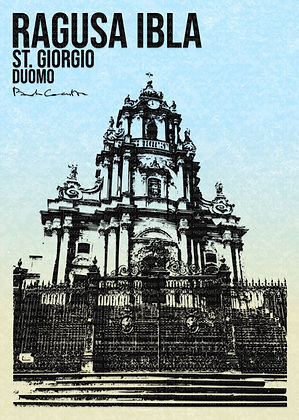
RAGUSA IBLA_ST. GIORGIO DUOMO
An architectural triumph crowning a monumental staircase, the Duomo of St. Giorgio is the supreme icon of Ragusa Ibla. Completed in the XVIII century, its magnificent three-towered facade and soaring neoclassical dome define the scenic beauty of the town. This masterpiece of the Late Baroque emerged as a symbol of rebirth following the 1693 earthquake, blending theatrical perspectives with the warm glow of local calcarenite stone.
#05
NOTO_ST. NICOLO' CATHEDRAL
Undisputed symbol of the Sicilian Baroque, the St. Nicolò Cathedral is a golden masterpiece rising at the heart of the "stone garden". Originally completed in 1776 following the earthquake of 1693, it stands as a sublime triumph of rebirth. Its monumental facade is crafted from the local limestone, celebrated for its unique golden glow that radiates with the sun's light. Masterfully restored after the 1996 collapse and reopened in 2007, the Cathedral remains today a timeless testament to human resilience and the eternal beauty of Noto.


#06
SIRACUSA_NATIVITA' DI MARIA SANTISSIMA CATHEDRAL
Standing as the crowning jewel of Ortigia island, the ancient heart of Siracusa, the Natività di Maria Santissima Cathedral is a sublime masterpiece of Sicilian Baroque, built upon the sacred columns of the ancient Greek Temple of Athena. The facade, masterfully reconstructed between 1728 and 1753 after the 1693 earthquake, is sculpted from the local limestone, a "blinding" white stone characterized by its ability to capture the Mediterranean glare. This unique material transforms the heart of Piazza Duomo into a living theater of bright light, where the brilliant daytime radiance softens into a warm, honeyed glow at sunset.
#07
ISPICA_ST. MARIA MAGGIORE BASILICA
A masterpiece of the Sicilian Baroque, the Basilica of St. Maria Maggiore rose during the XVIII century, rebuilt using the ivory-toned stones from the Church of St. Maria della Cava, destroyed after the 1693 earthquake. This act of recovery symbolizes the profound continuity and resilience of the community. The Basilica, with the iconic Loggiato del Sinatra embracing it, remains the spiritual hearth of Ispica. The square where they are located is the place where the nobility of the stone preserves the memory and the soul of its people through the centuries.


#08
ROSOLINI_ST. GIUSEPPE MOTHER CHURCH
Designed in the XVIII century, the Mother Church of St. Giuseppe is the structural hearth of Rosolini. Its monumental facade, transitioning from Late Baroque to Neoclassical, was carved from solid local limestone to dominate Piazza Giuseppe Garibaldi. This stone structure, where the gravity of matter meets the elegance of divine proportion, is a testament to the city's rebirth after the 1693 earthquake, symbolizing the definitive foundation and identity of the community.
#09
PORTOPALO DI CAPO PASSERO_TONNARA
Standing as a silent titan since the XVII century, this structure is the cornerstone of local identity. Built from the raw, ancient stone of the coastline, it echoes centuries of maritime toil and the Mediterranean soul. In addition to being a symbol of the industrial archaeology heritage, it remains a monument to the salt, the sea and the legendary tuna run. Today, its skeleton speaks of resilience, bridging a glorious past with the eternal horizon; the Tonnara is where history breathes through the ruins.
